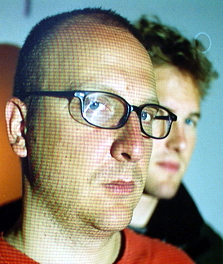
Questions by Rasa Smite and Ieva Auzina
Photo by Armin Smailovic
» International audiences know you mostly as the creator of your main
project, Makrolab, which was first presented at documenta X. After
Makrolab
you made series of projects (178 degrees East € Another Ocean Region,
Sundown, the Trust-System series, Solar, EMM and others) which explore
the
political and audio-visual aspect of the electromagnetic spectrum. Can
you
briefly explain your artistic strategies, and the tools and aims of
these
explorations?
MP: Makrolab's main aims are to explore and reflect upon three complex
and
dynamic fields of global activity: telecommunications, weather systems
and
migrations. The machine was built to receive, observe, process and
reflect
information that is generated within these fields. But the earlier work
that
led to Makrolab, especially the collaborative work I did with Brian
Springer, opened up a new chapter in the process of creating the
performance
Ladomir-faktura: Fourth Surface-the Surface of Contact! We used a lot
of
satellite telecommunications generated material, and this prompted me to
investigate further in the field.
The 178 degrees East work was realised
in
1997 in Australia, and was an actual investigation of the current
Australian
Telecommunications Interception Act: its legal framework. The response
from the public during the Code Red event was fantastic, and the law
firm
that we had hired to work on the project confirmed our legal
interpretations. We even had a strategic studies expert come and open up
the
event which brought the two very distant worlds together. It was
probably
the first friendly face-to-face between the tactical media community and
the
tactical and strategic community ...Echelon was discussed a lot in that
work
and also at Makrolab long
before the hype.
The other major work that uses the developing Makrolab
communications suite is the EMM-electronic media monitoring console and
lecture series, which is part of the World-Information.Org
infrastructure.
I am also developing a smaller unit for tactical work on a more limited
and
mobile basis . . .the reflection of the ever changing EM-spectrum must
be
constant. That is my aim. The tools are, of course, amateur-radio gear,
processing electronics, and lots of patience.
» You have just returned from Latvia where you were working on your
latest collaborative project with medialab RIXC from Riga. The project
was centred around an enormous radio telescope (d=32m), a former Soviet
military object which only recently has been made accessible for public
use.
Can you provide us with some impressions of working with this
extravagant
tool, as well as what role this kind of exclusiveopportunity plays in
your
artistic practice?
MP: The Irbene antenna array was built in the early 80's by the Soviet
military and was supposedly used for intercepting microwave
telecommunications from Western satellites, both military and civilian.
In
information warfare, this was an incredible tool and possibly a response
to
the interception systems the Western powers were setting up at the same
time, like the now famous Echelon. In any case, with the demise of the
Soviet Union, the Soviet army left Irbene and the two arrays that they
built
there (32m and 16m).
The same morning, Latvian scientists moved in as
they
wanted to keep and preserve this costly infrastructure for
radio-astronomical use, and so the Ventspils radio-astronomy centre was
established. Our Latvian hosts invited a group of international artists
and
media activists to a workshop in Irbene in August, and among other
things,
we wired up the array for tactical media use and investigation. As a
radio
amateur, it was quite an experience to be able to work with such
equipment.
The team I invited from my side (Borja Jeli and Aljo a
Abrahamsberg), did what we could in those two days, with some help from
the radio astronomers themselves. We have gathered audio and data
material
that we will use for our performance Signal-Sever! which will take place
in
Riga in early September. This performance is the continuation of the
work
that I have started with the event Solar at Ars Electronica in '98, and
basically it deals with the soundscapes that the electromagnetic
spectrum is
creating. It tries to materialise them in many ways; it is a
durational
performance that follows the status of the EM spectrum from sundown to
sunrise, with lots of sound, rhythms and grooves of course.
» One of the most challenging projects you did last year, in
collaboration
with Carsten Nicolai, is Polar, produced by Canon ArtLab in Tokyo. As I
understand it, Polar is a simulation the experience of a person finding
him/herself inside the virtual spaces of the electronic networks. It is
hard
to imagine... Can you give us some explanation how Polar functions as an
aesthetic project/object? And is it true that you are winning one of
the prizes in the Ars Electronica this year for it?
MP: Polar is not a simulation of the experience of the network, but
rather,
it's a tool to experience it in real-time . . . It's a machine that not
only translates and materialises the flows of information, but also the
meaning of the data which inhabits the networks. The system could be
described in two ways, through the visitors point of view and the data
package point of view. These are two very different perspectives, but
for a
quick "capsule" review, I could quote the description we did of the work
for
the Prix Ars Electronica this year. We envisioned the 7m X 7m X 4m
totally
connected, and tactile space as a complex tactile-matrix interface.
This
enables the visitor to experience the flow of data in the global and
local
networks in a completely immersive, yet cognitive way. The work was
inspired by the notion of the cognitive OCEAN as
described in Stanislaw Lem's and Andrey Tarkovsky's SOLARIS. The initial
conceptual equation was: OCEAN = MATRIX. The main outline of the work
was
based on the creation of two software and hardware "engines", the
so-called
POLAR ENGINE (with adjacent POLS, POLAR DICTIONARY and KNOWLEDGE BASE)
and
the CHANGE ENGINE (with adjacent TRACEROUTE VISUALISER, which consisted
of
two separate displays).
The
first was envisioned as an INPUT-ANALYSIS and CONSTRUCTION zone, and the
second as an OUTPUT-SYNTHESIS-EXPERIENCE zone.
These zones were defined both in conceptual sense, software and hardware
senses, and also in the environmental sense. We have defined a "ZONE" in
which the biological and physical was directly interacting with the
abstract-immaterial. One main question was posed in this process: HOW DO
WE
CONSTRUCT A COGNITIVE AND TACTILE EXPERIENCE OF THE SEAMLESS AND
NEAR-ABSTRACT MATRIX WITH IT'S ANALYSIS/CONSTRUCTION/TRANSFORMATION
INCLUDED
IN THE PROCESS? Basically, we wanted to create an interface between the
human body and senses and the matrix, which would, by its sheer
presence,
(let alone the activities of the humans), already transform the
structure of
the matrix that is being observed/experienced, and the structure of the
physical space that is being inhabited during this process. And indeed,
we
were nominated for the highest prize in the field for this work, the
Golden
Nica. Either this or the second prize will be ours, and the whole team
is
very proud of this.
» Do you believe in a future constructive relationship between art and
science in solving . . . let's say . . . major civilization problems
that could occur as a consequence of the latest technological and
economic
developments? What is your vision in this regard?
MP: I think that there is an urgent need to reflect upon these
developments
and develop strategies for sustainable growth and development that are
not
unilateral. As the development is centred now, I would say I am a
pessimist and that the global future will be a very troubled one. The
constructive creative art/science relationship is, of course, one of the
possible tools of this reflection/construction, and I do not see any
problems in this area except the cultural differences between these
fields.
But the global dynamics of change are very powerful and the knowledge
distribution is uneven, in both economic and geographic terms. This
needs to
change, and communication technology is one of the possible vehicles for
this change, but only if we will be able to liberate it from the grasp
of
the blind, solely capital-based use. The
electromagnetic spectrum is an immaterial field with very material
consequences, and unfortunately it has become a serious commodity. We
have
to liberate at least part of it, with all the democratic and
technological
means possible.
» As an artist from Slovenia dealing with extremely global technologies
and points of view, how do you see the political relation between the
margin
and centre? What is your impression of the possible new world order?
MP: Wow, what a question. I think that there is no fixed new world
order,
but rather a changing flux of power from state and nation-based
economies
to corporate-based power . . . I believe that in macroeconomical terms
this
process was too quick, there was a lack of reflection involved in it and
this gap also produced serious tensions between the many margins and the
few
centres of power. The social element is very much lacking in this
process...in all societal territories, and in micro and macro
environments.
This will have to change. The economy itself, at least the most
immaterial
and spectral part of it, the flux and transfer value of it, started
re-adjusting by itself last year.
But the reflection on the political front is far from happening, and
that is why I am a pessimist . . . preparing for Makrolab in the
Antarctic.
» makrolab.ljudmila.org
|